10 Strategic Systems for Scaling Sustainable Church Growth

Introduction: The Architecture of Expansion and Long-Term Spiritual Vitality
In the complex and rapidly evolving modern landscape of global ministry, church growth is often viewed with a profound mixture of holy excitement and strategic trepidation. For many church leaders, the deep-seated desire to reach more people with the transformative power of the Gospel is constantly balanced against a legitimate fear: the risk of losing the intimate, relational core that defines their spiritual community. They worry that as the numbers go up, the depth of individual discipleship might decrease. However, history and modern ministry practice show that sustainable growth is not a happy accident or a fluke of geography; it is the result of intentional, God-honoring systems designed to support multiplication without sacrificing spiritual health or individual care.
As churches scale—whether transitioning from a single-site powerhouse to a multi-site network, or evolving from a small neighborhood congregation into a mid-sized regional community—the fundamental challenges of leadership shift. They move from the domain of direct, one-on-one pastoral care to the broader horizon of organizational architecture. The relational systems that functioned beautifully for a church of 50 people will, without fail, crumble under the weight and complexity of a congregation of 500. To navigate this inevitable transition successfully, leaders must undergo a profound internal shift: they must move from being the "heroes" of the ministry to being the "architects" who design the platforms where the entire body of Christ can minister.
This article explores 9 strategic, data-driven systems that provide a robust framework for such sustainable expansion. By implementing these architectures—which are both technologically advanced and relationally focused—your church can build a foundation that scales organically. This ensures that every new person who walks through your digital or physical doors is not just a statistic to be counted, but a disciple in the making, fully known and fully cared for even as the flock expands beyond the immediate sight of any one leader.
1. The Multi-Channel Visitor Integration Pipeline
The first and most critical step in any sustainable growth strategy is not actually attraction, but retention. You can have the most compelling weekend experience in the entire region, but if your visitor integration process is what leaders call a "leaky bucket," your growth will inevitably hit a plateau. A truly scalable visitor integration pipeline utilizes integrated, automated workflows that are triggered the moment a guest makes their first point of contact—usually through a digital connect card, a QR code in the bulletin, or an SMS keyword.
This system should be designed as a defined, multi-week journey that builds trust rather than just collecting data:
- The Immediate Digital Handshake: An automated, yet warmly written, text message or email sent within minutes of the service ending, thanking them for their presence.
- The Mid-Week Personal Connection: A strategic, personalized follow-up from a curated welcome team member inviting the guest to a "Welcome to Church" lunch.
- The 14-Day Wellness Check: A follow-up from a volunteer within two weeks of their visit to answer specific questions, offer prayer, and suggest one clear next step.
By automating the administrative side and data entry of follow-up, you free your leaders and volunteers to focus entirely on the relational side of ministry, ensuring that no one falls through the cracks as the numerical complexity of your congregation increases.
2. Distributed Leadership and Span-of-Care Frameworks
One of the greatest inhibitors to long-term church growth is the "Pastor-as-Hub" model. When every single decision and every piece of intensive pastoral care must flow directly through the senior leader, the church is strictly limited by that individual’s physical and mental capacity. Sustainable growth requires a total paradigm shift toward a distributed leadership framework, where authority and care are delegated deep into the organization.
In this model, the senior leader focuses their energy on vision-casting and the high-level development of other key leaders, while the tactical execution of daily ministry is pushed down to department heads, ministry leads, and small group facilitators. This requires a robust, scalable system of "Leaders Leading Leaders." Crucially, each level of leadership must have a clear and manageable "span of care"—typically a ratio of 1 leader to 5 or 7 subordinates. This structure ensures that even in a megachurch of thousands, every single volunteer and leader is being discipled, supported, and held accountable, preventing the burnout that often accompanies rapid expansion.
3. Data-Informed Discipleship and Engagement Tracking
While spiritual growth is ultimately the work of the Holy Spirit, healthy ministerial systems must track the "rhythms of growth" that objectively indicate a maturing faith within the community. A data-informed discipleship system moves far beyond mere attendance numbers to track deeper engagement metrics that correlate with spiritual health. These KPIs might include:
- The percentage of the total congregation currently active in a small group.
- The number of individuals who have transitioned from being a "Sunday attender" to a "scheduled volunteer."
- The frequency of digital engagement with your church’s week-day discipleship resources.
- The progression of first-time givers into consistent, monthly financial partners.
By integrating your Church Management System (ChMS) with these engagement signals, your leadership team can identify "discipleship bottlenecks" in the journey. If your data shows that 80% of your visitors are returning for a second week, but only 10% are ever joining a small group, you know exactly where to focus your strategic energy and resource allocation.
4. The Digital Front Door UX Optimization
In the year 2026, the vast majority of people will visit your church online long before they ever consider stepping foot on your physical campus. Your digital front door—comprising your website, mobile app, social media profiles, and search engine presence—is the primary driver of new congregational growth. Optimization here involves far more than just having a beautiful design; it requires a strategic UX architecture designed with the seeker in mind.
A growth-oriented digital presence must answer three critical questions for a searcher within the first few seconds:
- Clarity of Logistics: What time do you meet, where is the parking, and is there an online option?
- Security for Families: What specific safety protocols and programs do you have for my children?
- Cultural Resonance: What is the core "vibe," mission, and theological posture of this community?
A scalable digital system ensures that your online presence is not just a static archive of past sermons, but a dynamic, interactive portal for immediate engagement and connection.
5. Seamless and Scalable Volunteer Onboarding Pipelines
Growth in a church naturally demands a constant, growing influx of new volunteers to staff everything from kids' ministry to technical production. However, a clunky onboarding process can quickly discourage potential servers before they even start. A strategic growth system simplifies the "path to service" through a centralized, automated digital onboarding portal.
This system should integrate everything from initial interest forms and automated background checks to training video modules and team placement notifications in one seamless, mobile-friendly workflow. By moving the heavy administrative "paperwork" into a digital environment, you significantly reduce the time elapsed from a person saying "I'm interested" to them being "active on a team." More importantly, this creates a standardized, high-quality experience that can be easily replicated across campuses.
6. Holistic Financial Stewardship and Generosity Architectures
Generosity is a vital spiritual discipline, but in a scaling church, it must be supported by robust technological systems. As a congregation grows, the sheer complexity of financial management increases exponentially. Implementing a unified, secure giving platform that seamlessly handles one-time tithing, recurring digital pledges, designated mission giving, and capital campaign tracking is essential for accurate budgeting and expansion forecasting.
Furthermore, sustainable churches implement what we call "Generosity Nurture" pathways. This involves providing automated, personalized impact reports to donors, sharing high-production-value video stories related to how their funds were used, and offering biblical financial literacy resources to the entire congregation. When people see the direct, kingdom-advancing impact of their stewardship, their trust and engagement deepens, providing the consistent resources necessary for further physical and digital expansion.
7. The Small Group Multiplication and Leadership Rhythm
The larger a church becomes numerically, the smaller it must feel relationally. Small groups are the "relational glue" that sustains growth and prevents the "back door" from being as large as the front door. However, if these groups stay together for three to five years without ever multiplying, they inevitably become closed relational circles that actually inhibit new growth by leaving no room for newcomers.
A multiplication-focused system builds "apprentice leaders" into every single group from day one. By setting a clear cultural expectation that healthy spiritual groups naturally grow and eventually divide to reach even more people, you create a self-sustaining engine for relational care and leadership development. This prevents the "membership plateau" where there is literally no more room in existing homes or classrooms for new people to find a genuine place of belonging. Healthy groups produce more groups.
8. Segmented and Integrated Communication Ecosystems
Communication breakdown is perhaps the most common casualty of rapid organizational growth. In a larger, more complex church, you need a multi-channel communication ecosystem that is capable of delivering the right message to the right segment of the congregation at the precisely right time.
This involves using the data in your ChMS to segment your audience into specific groups and then using automated email and SMS platforms to provide tailored, relevant updates. A scalable system avoids "information fatigue" by ensuring that people only receive the communications that are genuinely relevant to their current stage in the discipleship journey, rather than a generic blast that everyone eventually ignores. Precision in communication fosters trust and action.
9. The Adaptive Feedback Loop and Strategic Pivot System
Finally, a growing church must be, at its core, a learning church. A truly scalable growth system includes regular "rhythms of review" where quantitative data is analyzed alongside qualitative feedback from visitors and long-term members. In these sessions, staff performance is assessed against clear, agreed-upon KPIs and mission objectives.
This is about being the best possible stewards of the momentum and the people that God has provided. By building a leadership culture that is comfortable with "strategic pivots"—the humble ability to stop doing what isn't working and double down on the initiatives that are producing genuine fruit—you ensure that your church remains agile, relevant, and effective in an ever-shifting culture. Scaling requires the courage to change the "how" in order to protect and preserve the "why" of your ministry.
Conclusion: The Trellis and the Vine of Ministry
Ultimately, every system, every data point, and every architectural shift mentioned in this list serves a singular purpose: to create a stable, expansive platform where the Gospel can be heard, experienced, and lived out by as many people. Scales, metrics, and systems are not the theological goal themselves; they are merely the practical trellis that allows the vine of the Church to grow high, wide, and strong, providing shade and fruit for the entire community.
As you look at your own ministry context today, identify the specific "bottlenecks" where your current relational or administrative systems are straining under the weight of growth. By investing in the architecture of your church today, you are actively preparing for the expansion and the spiritual harvest that God has in store for tomorrow. Trust the architecture so you can focus on the Altar.
Try FaithBridge Today
Building and managing these complex systems manually can be an overwhelming burden for even the most dedicated ministry team. FaithBridge is designed from the ground up to be the "Architecture for Your Altar," providing the fully integrated tools your staff needs for visitor follow-up, volunteer management, and discipleship tracking. Let us handle the technical complexity of the systems so you can focus on the heart of the ministry: loving people and making disciples. Visit our website today to see how we can help your church scale sustainably, faithfully, and powerfully into the future.
Frequently asked questions
What is the most important system for church growth?
Retention is critical. A robust visitor integration pipeline ensures that new guests are followed up with relationally and technically, preventing the 'leaky bucket' phenomenon.
How do you maintain intimacy as a church grows?
Scaling intimacy requires a focus on small groups and distributed leadership. As the church grows larger numerically, it must grow smaller relationally through house churches and life groups.
Is data tracking necessary for spiritual growth?
While data doesn't replace the Holy Spirit, it acts as a flashlight for leadership, identifying where people are engaged and where bottlenecks in the discipleship journey exist.
Why is operational documentation important for growth?
Documentation ensures that a church's unique culture and workflows are transferable, removing the 'tribal knowledge' barrier that often prevents scaling and secondary site expansion.
Related articles
Church Growth
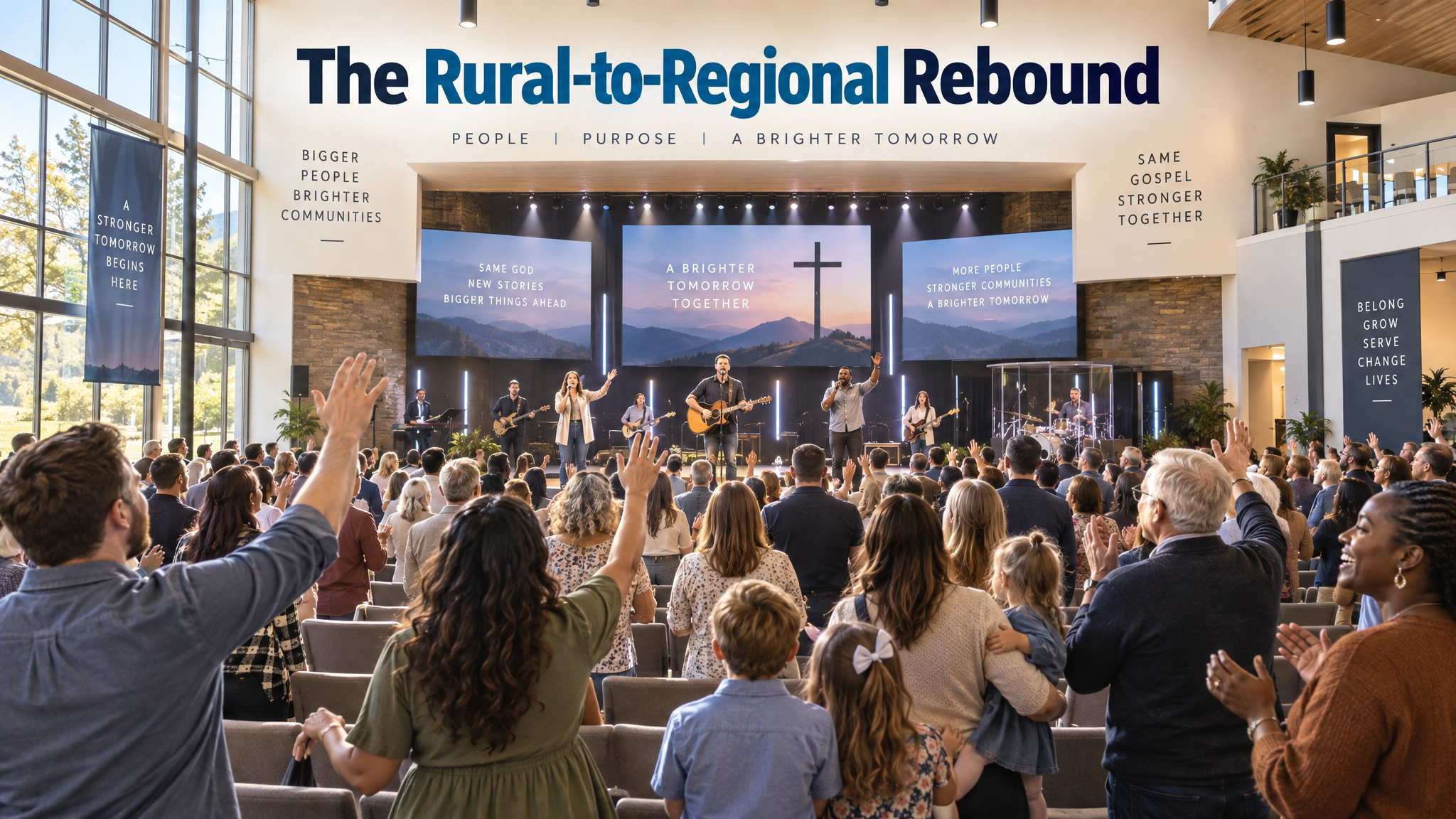
The Rural-to-Regional Rebound: A Case Study on Scaling Sustainable Church Growth Through Digital Integration at Northwood Community Church

Church Growth
The Data-Driven Expansion: A How-To Guide for Using Predictive Analytics to Identify High-Impact Locations for New Church Campuses

Discipleship
The Discipleship Engine: A How-To Guide for Designing Scalable Micro-Group Ecosystems for Sustainable Spiritual Formation
Explore FaithBridge