15 Data-Driven Indicators for Predicting and Catalyzing Sustainable Church Growth
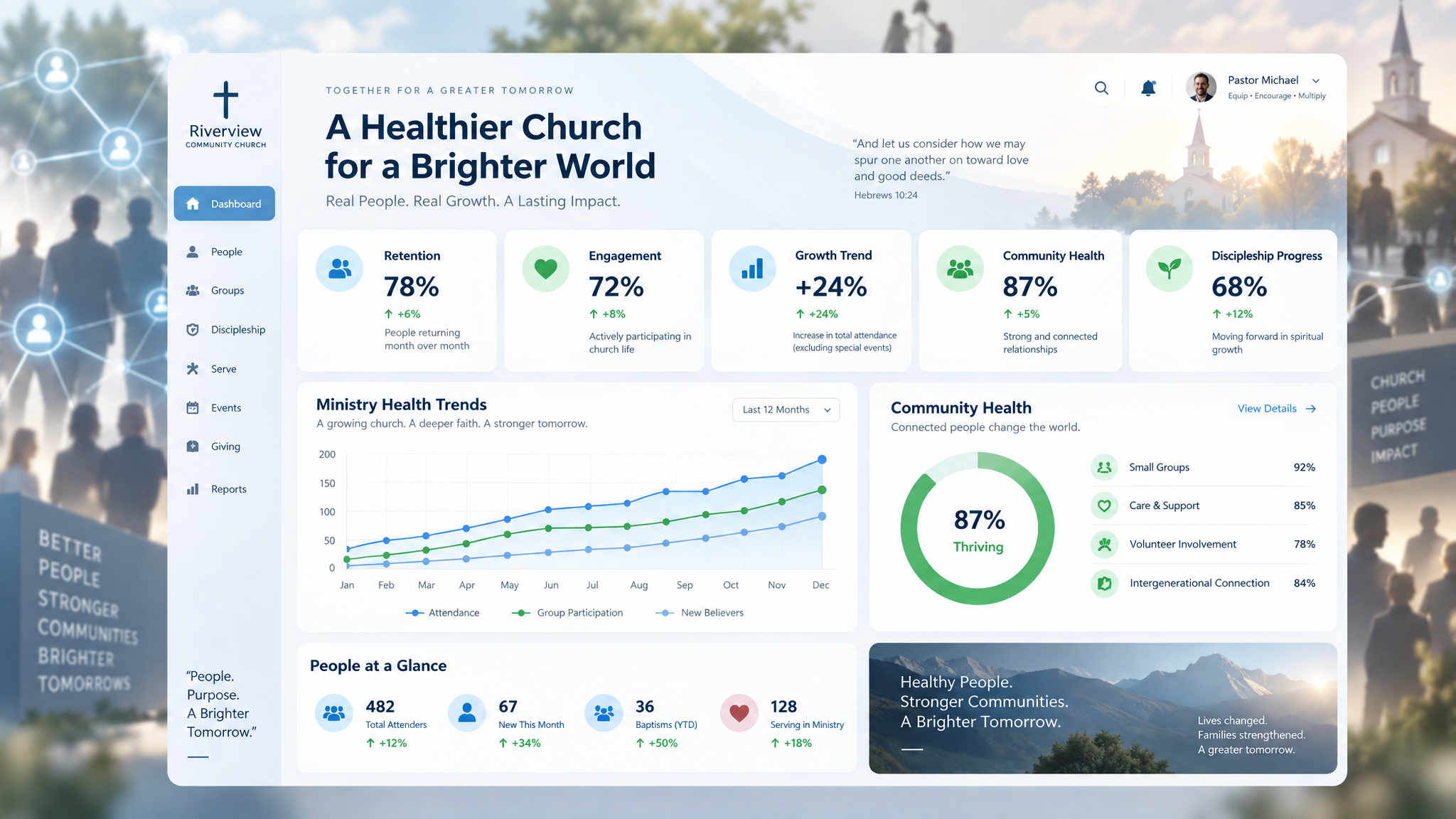
The New Metrics of Ministry: Why Data Matters for Sustainable Church Growth
For decades, the "business" of church growth was measured by three simple, yet arguably reductive, metrics: attendance, the building, and the basket. While these numbers provide a baseline for operational awareness, they rarely offer a true diagnostic into the long-term health or the sustainable future of a congregation. In the post-digital era, where engagement happens across multiple platforms and physical attendance is often preceded by months of virtual observation, church leaders need a more sophisticated dashboard.
Sustainable growth is not just about getting more people into seats; it is about building an infrastructure that can support those people, cultivate their spiritual maturity, and empower them to reach others. When growth is purely numerical, it often leads to burnout and systemic collapse. When growth is data-driven and health-focused, it becomes a movement that can last for generations.
Here are 15 data-driven indicators that not only predict growth but serve as catalysts for a sustainable ministry expansion.
1. First-Time Visitor Retention Rates
It is often said that the most expensive member of a church is the one who only visits once. The energy, marketing, and hospitality required to bring a new family through the doors are significant. However, the true indicator of growth is not the number of first-time visitors, but the percentage of those visitors who return within six weeks.
Tracking this metric allows you to evaluate the effectiveness of your "front door" experience. Is your greeting team too aggressive or too passive? Is the sermon content accessible to outsiders? If your retention rate is below 20%, your growth is like pouring water into a leaky bucket. Solving the retention problem is the first step toward sustainable expansion.
2. Volunteer Pipeline Saturation
A growing church requires a growing engine of service. We often measure the total number of volunteers, but a more potent indicator is "pipeline saturation"—the percentage of roles filled by individuals who are currently being mentored to lead those roles in the future.
If your children’s ministry is at 100% capacity but has 0% of its leaders in a "co-lead" or "apprentice" position, you are one crisis away from a service gap. Sustainable growth happens when you have a 1:1 ratio of leaders to future leaders. When people see a clear path from "helping out" to "leading," they are more likely to commit long-term.
3. Multi-Generational Giving Distribution
Financial health is a lagging indicator of spiritual engagement, but the distribution of that health is a leading indicator of longevity. If 80% of your budget is funded by 5% of your oldest members, your church is at risk.
Sustainable churches track giving across age demographics. Are your Gen Z and Millennial members beginning to tithe? Are you seeing incremental increases in the number of "first-time givers" each quarter? A diverse giving base ensures that the mission remains funded even as generations transition in leadership.
4. Small Group Participation Velocity
The "velocity" of small group participation measures how quickly a new member moves from attending a weekend service to joining a relational community. In a large church, people can easily get lost in the crowd. Small groups are where discipleship and care actually happen.
If the time between "first visit" and "joined a group" is shrinking, your church’s "stickiness" is increasing. A high percentage of the congregation in small groups (ideally above 60%) is one of the strongest predictors of future growth, as these individuals are more likely to invite friends and serve in ministry.
5. Digital Engagement vs. Attendance Ratio
In a hybrid ministry world, your "attendance" is no longer just the number of people in the room. It includes those watching the livestream, listening to the podcast, or engaging with your social media content throughout the week.
However, the key indicator is the ratio between these two. If your digital engagement is 10x your physical attendance, you have a massive "influence" but perhaps a "commitment" gap. Conversely, if you have zero digital engagement, you are failing to reach the next generation where they live. Sustainable growth balances high-reach digital strategy with high-touch physical presence.
6. Community Outreach Conversion
How many people in your local community know your church exists, and how many of those interactions result in a meaningful connection? If your church hosts a food pantry that serves 500 families a month, but zero of those families ever engage with the spiritual life of the church, you are running a localized non-profit, not necessarily a growing ministry.
Tracking "conversion" in this context doesn't mean forced proselytization; it means measuring how effectively your church bridges the gap between meeting a physical need and inviting someone into a community of faith.
7. Leadership Multiplication Ratio
This is the number of new leaders authorized or commissioned per year relative to your total staff size. If your staff does all the work, you are limited by their hours in the day. If your staff empowers others to do the work, you are limited only by the Holy Spirit.
A healthy multiplication ratio is a sign that the "priesthood of all believers" is being activated. When the congregation realizes they are the ministers, the potential for growth becomes exponential rather than linear.
8. New Giver Onboarding Speed
Similar to visitor retention, how long does it take for a new attendee to make their first contribution? This isn't about the dollar amount; it's about the "buy-in." Giving is an act of trust.
If your messaging around stewardship is clear and your digital giving tools are seamless (like those provided by FaithBridge), the friction between "wanting to help" and "actually helping" is removed. A faster onboarding speed for givers indicates a culture of clarity and trust.
9. Facilities Utilization Efficiency
Square footage is one of a church’s greatest assets and greatest liabilities. Many churches have buildings that sit empty 90% of the week. Sustainable growth involves utilizing your physical space for the community throughout the week.
Are your rooms being used for ESL classes, AA meetings, or co-working spaces? The more the community views your building as a "third space" (not home, not work, but a community hub), the easier it is for them to eventually walk into a Sunday service.
10. Staff to Member Ratio Trends
As a church grows, the ratio of staff to members often shifts. However, sustainable growth doesn't necessarily mean hiring more staff; it means hiring different kinds of staff.
Strategic churches track if their staff-to-member ratio is improving in terms of "efficiency." Are you hiring administrators to manage the burden, or are you hiring "equippers" who manage volunteers? If your staffing costs are rising faster than your discipleship metrics, your growth model is unsustainable.
11. Geographical Outreach Density
With modern mapping tools, you can see where your members live. If 90% of your congregation lives in one zip code, but that zip code is already 95% churched, you have limited room for growth.
Analyzing geographical density allows you to identify "blind spots." Perhaps there is a neighboring town with zero gospel presence where a significant portion of your digital audience resides. This data drives decisions on where to launch new campuses or planting initiatives.
12. Frequency of "Next Steps" Engagement
Most churches have a "Next Steps" class, but how many people actually complete it? Tracking the "completion rate" of your onboarding process is vital.
If people start the class but don't finish, you have a content or a culture problem. If they finish the class but don't join a team or a group, you have a "hand-off" problem. Sustainable growth requires a frictionless pathway from "just looking" to "fully engaged."
13. Digital Discoverability and SEO Performance
How do people find you when they aren't looking for you? When someone searches "daycare near me" or "help with my marriage," does your church show up in the results?
Your SEO (Search Engine Optimization) performance is a modern version of the church sign on the corner. If you aren't visible in the digital town square, your growth is limited to word-of-mouth. A data-driven church monitors its search rankings for community-focused keywords.
14. Youth and Young Adult Integration
The presence of children and teenagers is a sign of life, but their integration into the broader church is a sign of future health. Do your students serve in the main service? Do they have a voice in leadership?
If the "youth ministry" is a silo that never interacts with the "big church," those students will likely graduate from your church when they graduate from high school. Integration metrics help you predict whether your growth will survive the next decade.
15. Fiscal Reserves and Long-Term Sustainability
Finally, true sustainability requires a buffer. Does your church have 3-6 months of operating expenses in reserve? While we trust in God’s provision, prudent stewardship is a biblical mandate.
A church with zero reserves cannot take risks. It cannot launch a new mission, move into a new building, or respond to a community crisis. Financial stability provides the platform for spiritual risk-taking.
Practical Advice: How to Start Tracking Metrics
Moving a church toward a data-driven culture can be met with resistance. Some may feel it is "too corporate" or "unspiritual." The key is to frame the data as a tool for better stewardship of people, not just numbers.
- Start Small: Pick three of these indicators to track for the next six months. Don't try to overhaul your entire system overnight.
- Standardize the Data: Ensure that everyone is counting things the same way. If one pastor thinks "attendance" includes kids and another doesn't, your data is useless.
- Focus on Trends, Not Totals: A single Sunday’s attendance doesn't tell a story. A six-month downward trend in volunteer retention, however, is an urgent call for prayer and action.
- Celebrate the "Why": When you see an increase in small group participation, don't just report the number. Tell the story of a family that found community through that group.
Building for the Future
Sustainable growth is a marathon, not a sprint. By looking past the surface-level numbers and into the deep architectural markers of health, church leaders can build ministries that don't just survive but thrive in a changing world.
Data doesn't replace the Holy Spirit; it helps us see where the Spirit is already moving and where we might be putting up unintentional barriers to growth. By architecting your church around these 15 indicators, you are setting the stage for a ministry that will impact your community for years to come.
Take the next step in your ministry’s growth journey. FaithBridge provides the tools and insights you need to manage your congregation, streamline your giving, and empower your leaders. Join a community of forward-thinking church architects today and see how data-driven stewardship can transform your impact.
Frequently asked questions
Why is data important for church growth?
Data helps church leaders move beyond surface-level numbers like attendance to identify deep-seated cultural markers of health and engagement, allowing for more strategic and sustainable expansion.
What is the most important indicator of church health?
While all indicators matter, visitor retention and small group participation velocity are often the strongest predictors of long-term sustainable growth and community depth.
How can small churches begin tracking these metrics?
Start small by focusing on 2-3 key metrics like first-time visitor retention and volunteer pipeline saturation, using standardized tools to ensure data accuracy over time.
Related articles
Church Growth
The Rural-to-Regional Rebound: A Case Study on Scaling Sustainable Church Growth Through Digital Integration at Northwood Community Church

Church Growth
The Data-Driven Expansion: A How-To Guide for Using Predictive Analytics to Identify High-Impact Locations for New Church Campuses

Discipleship
The Discipleship Engine: A How-To Guide for Designing Scalable Micro-Group Ecosystems for Sustainable Spiritual Formation
Explore FaithBridge