The Institutional Integrity Blueprint: 10 Best Practices for Scaling Sustainable Church Operations and Administrative Oversight

The Institutional Integrity Blueprint: 10 Best Practices for Scaling Sustainable Church Operations and Administrative Oversight
In the journey of church growth, the transition from a small, family-like gathering to a medium or large-scale organization is often marked by an "administrative gap." As the spiritual mission expands, the operational infrastructure that supports it must also evolve to ensure long-term sustainability and integrity. Scaling a church is not merely about increasing attendance; it is about architecting systems that can hold the weight of a growing community without compromising the mission or the well-being of the leaders.
Effective church management is the silent partner of spiritual growth. When operations are optimized, pastors and ministry leaders are freed to focus on their primary calling—ministering to the people. Conversely, when administrative systems fail, the resulting chaos can lead to burnout, financial mismanagement, and a loss of public trust. To help your ministry navigate this transition, we have identified ten essential best practices for building a robust and scalable institutional blueprint.
1. Professionalize the Human Resources Function
One of the first challenges in a scaling church is the professionalization of staff management. In the early stages, hiring is often informal and based on personal connections. While relationship-based hiring has its merits, a growing organization requires clear job descriptions, formal performance reviews, and standardized compensation structures.
Establishing a professional HR framework ensures that staff members are treated fairly and have a clear path for professional development. This includes creating employee handbooks, implementing conflict resolution protocols, and ensuring compliance with local labor laws. By treating your staff as high-value assets rather than just "helpers," you create a culture of excellence and mutual respect.
2. Implement Tiered Financial Internal Controls
Financial transparency is the cornerstone of institutional integrity. As budgets grow, the risk of error or mismanagement increases. Scaling churches must implement a multi-layered system of checks and balances.
This involves separating financial duties so that no single individual has total control over funds. For example, the person who records donations should not be the same person who makes bank deposits. Additionally, implementing automated expense approval workflows and conducting regular third-party audits can provide the board and the congregation with the assurance that resources are being stewarded with the highest degree of accountability.
3. Standardize Operational Workflows
In a scaling environment, "the way we've always done it" often becomes a bottleneck. To achieve operational excellence, ministries must move toward standardized, documented workflows for recurring tasks. Whether it is the process for onboarding new volunteers, managing facility rentals, or coordinating large-scale events, having a "playbook" ensures consistency and reduces the mental load on staff.
Standardization allows the church to replicate success across different departments and campuses. It also makes it easier to train new staff members, as they have a clear reference for how tasks should be performed. In the digital era, leveraging workflow automation software can further streamline these processes, ensuring that nothing falls through the cracks.
4. Prioritize Data-Driven Decision Making
Intuition is valuable in ministry, but as a church grows, data becomes an indispensable tool for strategic planning. Scaling churches need to move toward a data-informed culture where decisions are backed by accurate metrics. This includes tracking attendance trends, giving patterns, volunteer retention rates, and engagement levels across different ministry areas.
By analyzing this data, leadership can identify which programs are having the greatest impact and where resources might be wasted. However, it is crucial to remember that data represents people. The goal of tracking metrics is not just to see the numbers go up, but to better understand how to serve the congregation and fulfill the church's mission.
5. Build an Empowered and Accountable Board
A healthy church management structure requires strong oversight. An empowered board of directors (or elders) provides the necessary accountability for the lead pastor and the executive staff. The board's role is to focus on high-level governance, financial oversight, and strategic alignment, rather than the day-to-day minutiae of ministry operations.
To scale effectively, the board must be composed of individuals with diverse skill sets—including legal, financial, and organizational expertise. Regular board training and clear bylaws are essential for ensuring that the relationship between the board and the pastoral staff remains healthy and productive.
6. Foster a Culture of Radical Transparency
Trust is the currency of the church. In a scaling organization, maintaining that trust requires a commitment to radical transparency. This means proactively communicating with the congregation about the church’s financial health, strategic goals, and operational challenges.
Transparency goes beyond just presenting a yearly budget. it involves creating regular opportunities for dialogue between the leadership and the members. When people feel that they have a clear understanding of where the church is going and how it is getting there, they are more likely to invest their time, talent, and treasure in the mission.
7. Invest in Interoperable Technology Stacks
As operations become more complex, the need for integrated technology becomes undeniable. Many growing churches struggle with a "fragmented tech stack"—where different departments use different software that doesn't talk to each other. This leads to data silos and administrative friction.
Scaling churches should prioritize interoperable systems that allow for a unified view of the congregation. Using a robust Church Management System (ChMS) that integrates with your financial software, email marketing tools, and website allows for seamless data flow and more efficient ministry operations. Technology should serve as a bridge, not a barrier, to connection.
8. Develop a Scalable Leadership Pipeline
One of the biggest risks to a growing church is "leadership debt"—the gap between the leaders you have and the leaders you need. A sustainable institutional blueprint must include a proactive strategy for identifying, training, and empowering future leaders at all levels of the organization.
This involves creating clear pathways for volunteer leadership and providing ongoing professional development for staff. By building a culture of mentorship and delegation, you ensure that the organization's growth is not tied to the capacity of a single charismatic leader, but is supported by a broad base of capable individuals.
9. Design Facilities for Flexibility and Multi-Use
Physical infrastructure can often be the most significant constraint on a church's growth. When designing or renovating facilities, scaling churches should prioritize flexibility. Spaces that can serve multiple functions—such as a lobby that transforms into a community gathering space or classrooms that can host mid-week training—provide the best return on investment.
Operational oversight also includes a long-term facility maintenance plan. Neglected buildings can become a massive financial burden and a deterrent to new visitors. By treating your facilities as a strategic tool for ministry, you ensure that your physical environment supports rather than hinders your mission.
10. Stay Anchored in the "Why"
Amidst the spreadsheets, bylaws, and software updates, it is easy to lose sight of the primary goal: making disciples and serving the community. The final best practice for scaling sustainable church operations is to ensure that every administrative decision is filtered through the church's core mission and values.
Institutional integrity is not an end in itself; it is a means to an end. By building a robust operational foundation, you are creating a "trellis" that allows the "vine" of the ministry to grow and flourish. When the administrative systems are healthy, the Gospel can be proclaimed with greater clarity and the church can serve its community with greater impact.
Conclusion: Building for the Future
Scaling a church requires a unique blend of spiritual vision and operational wisdom. By implementing these ten best practices, your ministry can build an institutional blueprint that stands the test of time. Integrity, transparency, and efficiency are not just business concepts; they are biblical principles that, when applied to church management, enable a congregation to reach its full potential.
Operational excellence is a journey, not a destination. As your church continues to grow, your systems will need to continue to adapt. But with a solid foundation of institutional integrity, you can move forward with confidence, knowing that your ministry is built to last.
Ready to Scale Your Church Operations?
FaithBridge is designed to help churches like yours manage the complexities of growth with ease. From automated workflows to integrated data analytics, our platform provides the tools you need to lead with excellence. Visit FaithBridge.app today to learn how we can support your ministry’s next chapter.
Frequently asked questions
Why is institutional integrity important for churches?
Institutional integrity ensures that a church's operations align with its spiritual mission, building trust with the congregation and providing a stable foundation for long-term growth and ministry impact.
What is the most common administrative challenge for scaling churches?
The most common challenge is the "administrative gap," where informal, relationship-based systems become insufficient for the complexity of a larger organization, leading to inefficiencies and risks.
How can technology improve church management?
Integrated technology stacks (interoperable systems) reduce administrative friction, eliminate data silos, and provide leaders with accurate, data-driven insights to make informed decisions.
What role does the board play in scaling operations?
The board provides essential oversight and accountability, focusing on high-level governance and strategic alignment to ensure the church's resources are stewarded effectively.
Related articles

Church Management
The Administrative Architecture: 10 Strategic Frameworks for Scaling Sustainable Operations in High-Growth Faith Communities
Church Growth
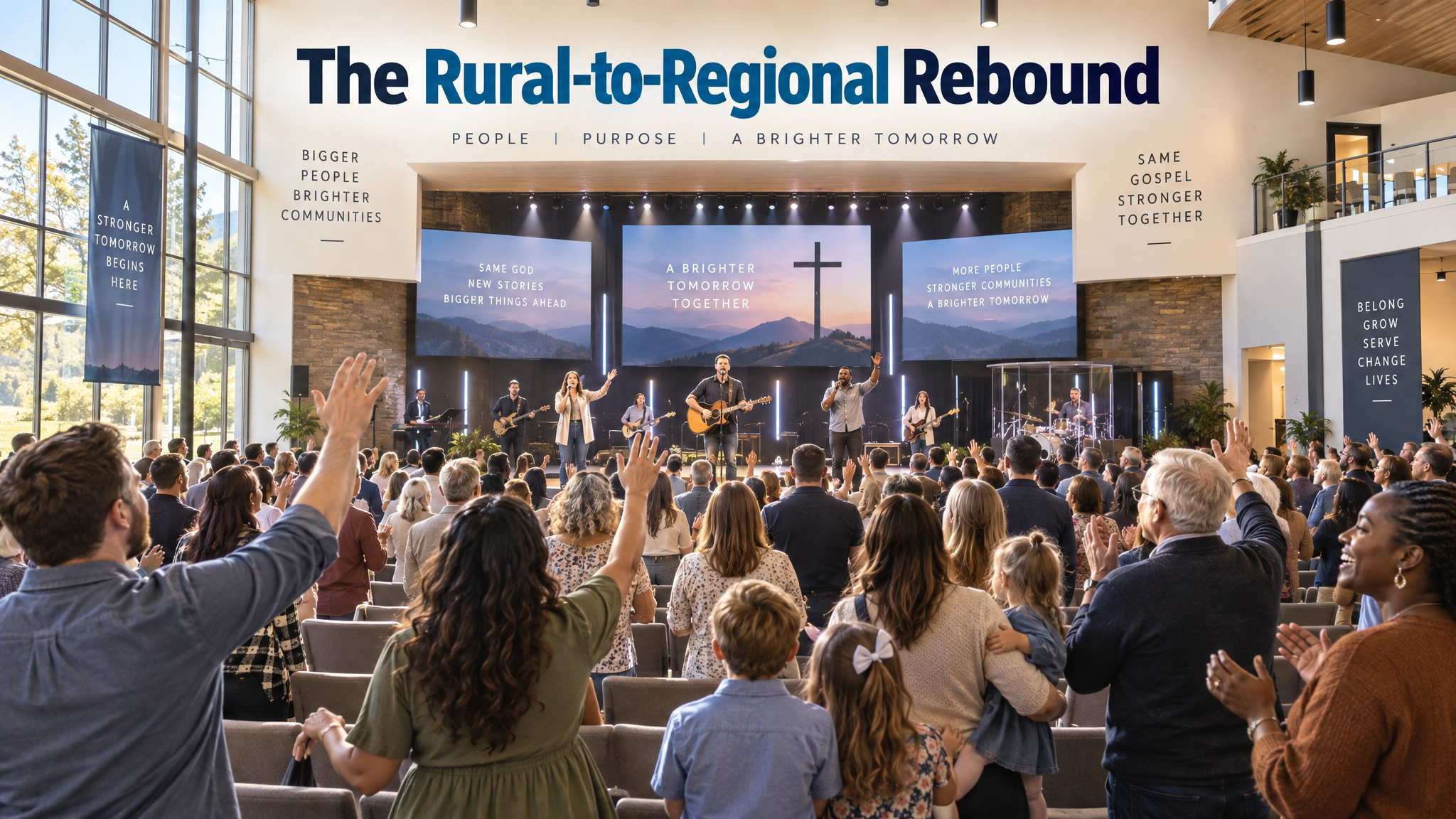
The Rural-to-Regional Rebound: A Case Study on Scaling Sustainable Church Growth Through Digital Integration at Northwood Community Church

Discipleship
The Discipleship Engine: A How-To Guide for Designing Scalable Micro-Group Ecosystems for Sustainable Spiritual Formation
Explore FaithBridge