The Interoperable Sanctuary: A How-To Guide for Architecting a Unified API-First Church Technology Ecosystem that Scales
Introduction
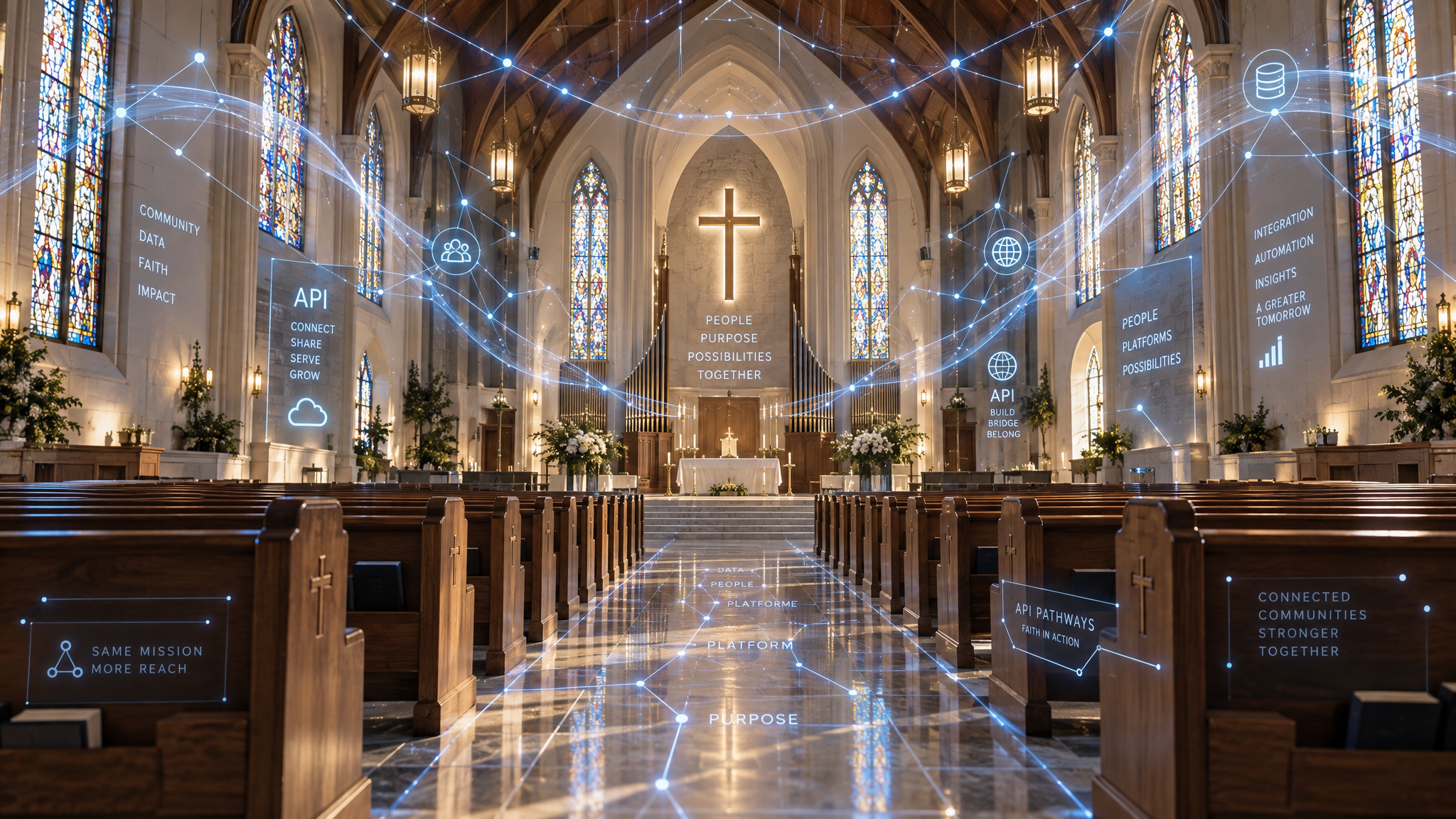
In the rapidly evolving landscape of modern ministry, the "digital front door" has become as important as the physical one. Yet, many churches find themselves trapped in a "Frankenstein’s Monster" of disconnected systems: a legacy member database here, a standalone giving platform there, and a separate communication tool that doesn't talk to either. This fragmentation doesn't just create administrative headaches; it stifles growth and prevents the kind of seamless, personalized discipleship that 21st-century congregants expect.
The solution isn't just buying better software; it's architecting a unified, interoperable technology ecosystem. By adopting an API-first approach, church leaders can build an infrastructure where data flows freely between platforms, empowering staff with real-time insights and providing members with a frictionless spiritual journey. This guide will walk you through the strategic steps to architect a "Future-Ready Sanctuary" that scales with your mission.
Understanding the API-First Philosophy in Ministry
Before diving into technical specifications, it is crucial to understand the shift in mindset required for modern church technology. Historically, churches sought "all-in-one" platforms. While these promised simplicity, they often resulted in "jack-of-all-trades, master-of-none" solutions where the giving module was weak or the database was inflexible.
An API-first (Application Programming Interface) philosophy flips this. It assumes that you will use "best-of-breed" tools for different functions—such as FaithBridge for engagement, a dedicated platform for high-level accounting, and a specialized tool for video streaming—but ensures they are built to talk to each other. In an API-first ecosystem, the "integration" is not an afterthought; it is the foundation.
The Benefits of Interoperability
When your systems are interoperable, you unlock several key advantages:
- Single Source of Truth: You no longer have three different email addresses for the same family.
- Automated Workflows: A first-time donor can automatically be tagged in your engagement system for a follow-up series.
- Data-Driven Discernment: Leaders can see patterns—such as a drop in giving often preceding a drop in attendance—allowing for proactive pastoral care.
Step 1: Mapping Your Data Lifecycle
The first step in architecting your ecosystem isn't looking at code; it's looking at people. You must map the "journey" of a congregant from their first interaction to deep leadership.
Identify Key Interaction Points
Ask your team: Where do we collect data?
- Website visits and form completions
- In-person and online giving
- Event registrations
- Volunteer check-ins
- Small group attendance
Define the Data Anchor
Every ecosystem needs an "anchor"—typically your Church Management System (ChMS) or a robust engagement platform like FaithBridge. This is where the definitive record of a person lives. Every other tool in your stack should either feed data into this anchor or draw data from it.
Step 2: Evaluating Your Current Stack for "Connectivity Readiness"
Audit your existing tools. For each one, determine if it has a robust, documented API. If a tool doesn't allow you to export data automatically or receive data from other systems, it is a "data silo" that will eventually limit your growth.
The "Integration Tier" Audit
- Tier A (Integrated): Tools that have native integrations or easy Zapier/Make connections.
- Tier B (Connectable): Tools with open APIs that require some custom development.
- Tier C (Siloed): Legacy tools with no API. Plan to phase these out.
Step 3: Architecting the "Middleware" Layer
To make different tools talk to each other, you often need "middleware." This acts as the translator between systems.
Leveraging No-Code Integrators
For most churches, platforms like Zapier or Make.com are sufficient. They allow you to say: "When someone registers for a Baptism Class in our event tool, create a task for the Discipleship Pastor in our project management tool."
Custom API Endpoints
For larger or more complex ministries, you may need a custom middleware layer (often hosted on AWS or Azure) that handles complex logic—such as calculating a "Maturity Score" based on data from five different platforms.
Step 4: Prioritizing Security and Data Privacy
In an interoperable world, data is constantly moving. This increases the "attack surface" for potential cyber threats. Your architecture must prioritize security from day one.
Implementing OAuth and Token-Based Auth
Never hard-code passwords into your integration scripts. Use secure OAuth protocols or rotate API tokens regularly.
Data Governance Policies
Ensure you have clear policies on who can access what data. An interoperable system shouldn't mean that every volunteer has access to the church's financial records.
Step 5: Building for Scalability and "Cloud-Native" Flexibility
A truly scalable infrastructure is "cloud-native." Avoid on-premise servers that require physical maintenance and manual backups. By leveraging cloud-based APIs, your infrastructure can handle a 10x spike in traffic (like on Easter Sunday) without crashing.
Embracing Microservices
Instead of one massive, monolithic system, think of your tech as a collection of "microservices." If you need to switch your email provider, you should be able to "unplug" the old one and "plug in" a new one via API without breaking the rest of your ecosystem.
Conclusion: The Path Toward a Frictionless Ministry
Architecting an interoperable sanctuary is not a one-time project; it is a commitment to a new way of operating. It requires moving away from the convenience of "silos" toward the power of "connections." When your technology works in harmony, it disappears into the background, allowing your staff to focus less on data entry and more on discipleship.
By following this API-first roadmap, you aren't just building a tech stack; you are building a scalable foundation for the future of your church—one where every digital interaction serves the mission of making disciples.
Call to Action: Experience the Power of Integrated Ministry
Ready to move beyond data silos and architect a truly connected church experience? FaithBridge is built with an API-first heart, designed to be the interoperable engine of your modern ministry. From seamless giving integrations to automated discipleship pathways, FaithBridge helps you build the unified ecosystem your mission deserves.
Try FaithBridge Today and start building your future-ready sanctuary.
Frequently asked questions
What is an API-first approach for churches?
An API-first approach means choosing software that is built to connect with other tools. Instead of relying on a single closed system, you build an ecosystem where specialized tools—like giving, engagement, and accounting—seamlessly share data via Application Programming Interfaces.
Why is interoperability important for ministry?
Interoperability eliminates manual data entry, ensures a single source of truth for member records, and allows leaders to see holistic patterns in congregant engagement, leading to more proactive and personalized pastoral care.
Do I need a developer to build an integrated church tech stack?
Not necessarily. Many modern church tools have native integrations or can be connected using no-code platforms like Zapier or Make.com, which allow you to create automated workflows between systems without writing code.
How does an API-first stack help with church growth?
A unified stack scales more easily than legacy systems. It allows you to automate follow-ups for new visitors, track engagement metrics in real-time, and quickly add or upgrade tools as your congregation’s needs evolve.
Related articles

Church Technology
The Artificial Intelligence Advantage: 7 Strategic Use-Cases for Empowering Small-Team Ministry Operations
Church Growth
The Rural-to-Regional Rebound: A Case Study on Scaling Sustainable Church Growth Through Digital Integration at Northwood Community Church
Discipleship
The Discipleship Engine: A How-To Guide for Designing Scalable Micro-Group Ecosystems for Sustainable Spiritual Formation
Explore FaithBridge