The Scalability Framework: A How-To Guide for Designing High-Capacity Leadership Pipelines for Sustainable Church Expansion

The Scalability Framework: A How-To Guide for Designing High-Capacity Leadership Pipelines for Sustainable Church Expansion
As a church begins to experience consistent growth, one of the most critical challenges it faces is not a lack of vision or even a lack of resources, but a lack of leaders. The ability to scale effectively depends directly on the capacity of your leadership pipeline. Without a robust system to identify, train, and deploy new leaders, growth will eventually hit a ceiling, often resulting in "leadership burnout," "growth fatigue," or a plateau in cultural health.
In the modern ministry landscape, growth is no longer just about attendance numbers; it is about the "spiritual throughput" of your community—how effectively you are moving people from the margins to the mission. This guide provides a comprehensive framework for architecting a high-capacity leadership pipeline designed for the modern, scaling church. By moving from a person-dependent model to a system-driven framework, you can ensure that your church’s expansion is both sustainable and spiritually healthy.
Understanding the Leadership Ceiling in Church Growth
Most churches operate with a "one-to-many" leadership model, where a small group of senior leaders is responsible for the majority of decision-making and discipleship. While this works in the early stages, it becomes a significant bottleneck as the congregation grows. For sustainable expansion, you must transition to a "many-to-many" model—a decentralized network of leaders who are empowered to carry the ministry forward.
The Problem with Personality-Driven Leadership
When leadership is concentrated in a few highly gifted individuals, the organization is vulnerable to "single-point failure." If a key leader leaves, becomes ill, or simply becomes overwhelmed, the entire ministry's momentum stalls. Sustainable growth requires an interoperable infrastructure that can thrive independently of any single personality. This transition requires a shift in mindset: moving from being a "minister" to being a "developer of ministers."
Identifying the Capacity Gap
Before you can build a pipeline, you must analyze your current leadership capacity. Calculate your "leader-to-congregant" ratio across various ministries—from small groups to tech teams. If your ratios are stretching beyond healthy limits (e.g., more than 10-12 small group leaders per coach), you have a capacity gap. This gap is the most accurate predictor of a future growth plateau. If you don't have enough leaders to care for the people you have, the system will naturally stop inviting new ones to avoid a total collapse.
Phase 1: Designing the Pipeline Architecture
A successful leadership pipeline is not a one-off training program or a weekend seminar; it is a continuous, interoperable system that moves individuals from initial engagement to senior-level oversight.
Defining the Levels of Leadership
Divide your leadership structure into clear, distinct tiers. A standard framework usually includes:
- Lead Yourself (Volunteer): Individuals serving in basic ministry roles (e.g., greeters, tech team).
- Lead Others (Team Lead): Individuals managing a small team of volunteers.
- Lead Leaders (Coach/Manager): Individuals overseeing multiple team leads within a department.
- Lead Ministries (Director/Staff): Individuals responsible for entire departments or campuses.
- Lead the Mosaic (Senior Leadership): Individuals responsible for the strategic direction of the entire multi-site organization.
Creating Clear Competency Maps
For each level, define the specific competencies required. These should be categorized into "Character" (spiritual maturity and integrity), "Calling" (alignment with the church's unique vision), and "Competency" (specific technical or relational skills). Clear maps remove the ambiguity from leadership development and provide individuals with a transparent, encouraging path for growth. It allows them to answer the question: "What does it take to get to the next level?"
Phase 2: The Identification and Recruitment Engine
The most effective leadership pipelines are proactive, not reactive. You shouldn't wait for a position to become vacant to look for a leader; you should be identifying potential leaders before they even know they have the gift.
Leveraging Data for Talent Scouting
Modern church management systems (like FaithBridge) allow you to track engagement levels, spiritual gifts, and serving history. Use these data points to identify "high-potential" individuals who are consistently showing up and contributing. For example, individuals who participate in both small groups and various serving teams often exhibit the "leader DNA" you need. This isn't about mechanizing leadership, but about using technology to ensure no potential leader falls through the cracks.
The "First Serve" Strategy
Implement a low-barrier-to-entry "First Serve" program that allows newcomers to test their gifts in a safe environment. This serves as the primary intake valve for your pipeline. During this phase, focus on observing their character and consistency rather than their expertise. Are they reliable? Do they treat others with respect? Are they teachable? These "soft signals" are far more important than their ability to use a soundboard or lead a prayer.
Phase 3: The Integrated Training Framework
Training should be ongoing, bite-sized, and accessible. The day of the eight-week evening seminar is largely gone; today’s leaders need "on-demand" development that fits into their busy schedules without sacrificing depth.
The "I Do, We Do, You Do" Mentorship Model
This classic apprenticeship model remains the most effective way to train leaders because it mimics the way Jesus trained His disciples.
- I Do: The apprentice observes the mentor in action.
- We Do: The mentor and apprentice perform the task together, sharing responsibilities.
- You Do: The apprentice leads while the mentor provides constructive feedback and coaching. This ensures that practical skills are transferred in a relational context, maintaining the specific "spiritual DNA" of your ministry while building deep trust.
Digital-First Learning Management
Implement a digital platform where potential leaders can access training videos, leadership manuals, and spiritual development resources. By providing these resources digitally, you allow leaders to learn at their own pace—whether they're on a morning commute or a lunch break. This dramatically increases the scalability of your training process because the "information transfer" phase is decoupled from the "relational coaching" phase.
Phase 4: Navigating the 'Chasm' of Multi-Site Expansion
As a church expands to multiple locations, the leadership pipeline must become even more robust. The "chasm" between a single-site and a multi-site model is where many pipelines fail.
Centralized Support vs. Local Autonomy
Designing a pipeline for multi-site requires a balance. You need centralized systems for training and standards to ensure consistency (the "One Church" feel), but you need local autonomy to allow campus leaders to adapt to their specific neighborhood contexts. A high-capacity pipeline empowers campus leaders to identify and train their own people using the shared central tools.
The Specialist vs. Generalist Transition
In the early days of growth, you need "generalist" leaders who can wear many hats. However, as you scale, the pipeline must produce "specialist" leaders who can go deep into specific areas like digital ministry, children's safety protocols, or complex stewardship management. Your pipeline should offer specialized tracks that allow leaders to lean into their unique giftings.
Phase 5: Deployment and Strategic Oversight
A pipeline is only effective if it leads to meaningful deployment. Once a leader has completed their training, they must be given real authority and responsibility—not just a title.
Empowering Through Trust-Based Delegation
Delegation is not just about offloading tasks; it’s about entrusting others with the weight of the vision. Ensure that your senior staff is trained in "empowering leadership"—the ability to set outcomes and goals while allowing their team to determine the best methods to achieve them. This builds ownership and longevity within your leadership culture.
Implementing Healthy Feedback Rhythms
Continuous expansion requires a culture of constant improvement and radical transparency. Establish regular "huddles" or "one-on-ones" where leaders receive coaching and encouragement. Use these touchpoints not just for operational updates, but for spiritual care. A healthy leader is a sustainable leader. If you only talk about tasks, you'll burn them out; if you talk about their soul, you'll build them up.
Measuring Pipeline Efficiency: The Key Metrics
To ensure your leadership pipeline is functioning correctly, you must track more than just the number of volunteers. You need "health metrics" that indicate the quality and sustainability of your leadership culture.
The Succession Ratio
How many of your key leadership roles have a designated "number two" who is currently being trained? A healthy pipeline should have a 1:1 or 1:2 succession ratio for all critical roles.
Movement Velocity
How long does it take for a new "First Serve" volunteer to move to a Level 2 or Level 3 leadership role? If the velocity is too slow, your pipeline is clogged; if it's too fast, you're likely neglecting character development.
The Role of Technology in Scaling Your Leadership Culture
Architecting a pipeline of this scale manually is nearly impossible in a growing church of several hundred or thousand members. You need an "intelligence infrastructure" that can support your human efforts. This is where FaithBridge becomes an indispensable partner in your growth journey.
Automated Tracking and Workflow Automation
With FaithBridge, you can automate the movement of individuals through your pipeline. From the moment a new member expresses interest in serving via a digital connection card, the system can trigger onboarding emails, schedule training sessions, and alert coordinators when a volunteer is ready to step into a leadership role. This ensures that no one is overlooked in the "noise" of growth.
Integrated Analytics for Growth Prediction
FaithBridge’s advanced analytics dashboard gives you a real-time view of your leadership health across all campuses. You can see at a glance where your pipeline is working and where it’s stalling. If the children's ministry at Campus A is growing faster than its leadership pipeline, FaithBridge will flag that as a "capacity risk," allowing you to make data-driven decisions about staff allocation and campus expansion before a crisis occurs.
Conclusion: Building for the Future
Sustainable church expansion is not just about increasing your numbers; it’s about increasing your capacity to minister to those people effectively. By designing a high-capacity leadership pipeline, you are building the "infrastructure of invitation"—a system that ensures your church can welcome new people without compromising the quality of their discipleship or the sanity of your staff.
Don't let leadership shortage be the ceiling of your vision. Start architecting your leadership pipeline today, and build a foundation that can sustain the growth God has in store for your community.
Ready to Scale Your Ministry?
If you're ready to move from manual, fragmented processes to a high-capacity growth system, it’s time to explore what FaithBridge can do for your church. Our unified platform is designed to help church leaders architect sustainable systems for discipleship, engagement, and exponential expansion.
[Try FaithBridge Today] and see how we can help you turn your vision for growth into a scalable, sustainable reality.
Frequently asked questions
Why is a leadership pipeline critical for church growth?
Growth often hits a ceiling when the leader-to-congregant ratio becomes unsustainable. A pipeline provides the infrastructure to decentralized leadership, allowing growth to continue without burning out existing staff.
How do I identify potential leaders in a large congregation?
Use engagement data and 'First Serve' programs to look for consistency and character. Proactive identification is more effective than reactive recruitment when a vacancy occurs.
Can I use digital tools for leadership training?
Yes, digital-first learning platforms allow for scalable information transfer, freeing up mentors to focus on relational coaching and spiritual formation rather than just logistics.
What is the 'I Do, We Do, You Do' model?
It is an apprenticeship framework where the mentor performs the task (I Do), then does it with the apprentice (We Do), and finally lets the apprentice lead while providing feedback (You Do).
Related articles
Church Growth
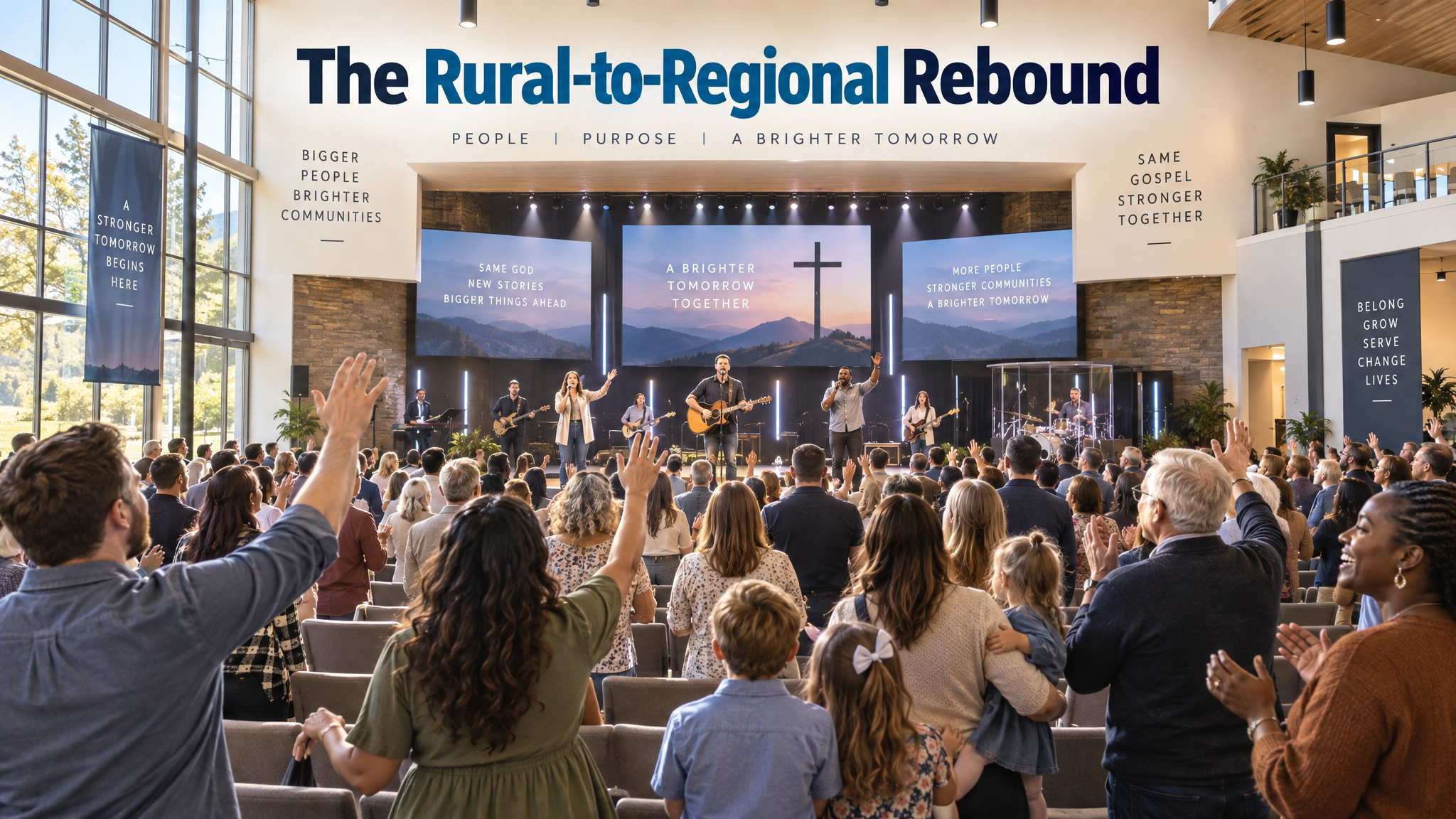
The Rural-to-Regional Rebound: A Case Study on Scaling Sustainable Church Growth Through Digital Integration at Northwood Community Church

Church Growth
The Data-Driven Expansion: A How-To Guide for Using Predictive Analytics to Identify High-Impact Locations for New Church Campuses

Discipleship
The Discipleship Engine: A How-To Guide for Designing Scalable Micro-Group Ecosystems for Sustainable Spiritual Formation
Explore FaithBridge