The Sustainable Growth Framework: 10 Strategic Systems for Scaling Your Church Without Losing the Heart of Ministry

The Sustainable Growth Framework: 10 Strategic Systems for Scaling Your Church Without Losing the Heart of Ministry
Scaling a church is one of the most challenging transitions any pastoral leadership team will face. It is a season marked by both profound excitement and significant risk. As the congregation grows, the systems that once supported a close-knit community often begin to strain and, eventually, break. The transition from a "small church" feel to a "large church" impact requires more than just more chairs in the sanctuary; it requires a fundamental shift in how the church operates, communicates, and cares for its people.
The danger of rapid growth is the loss of the very thing that likely attracted people in the first place: the sense of belonging and the intimacy of ministry. When growth happens without a corresponding increase in systemic health, the church can become a "leaky bucket," where new visitors enter through the front door but slip out the back just as quickly, feeling overlooked or disconnected.
To grow sustainably, church leaders must architect systems that allow for expansion while preserving the relational heart of the ministry. This requires moving from a hero-led model to a system-led model—where the vision is carried not just by a single leader, but by a robust framework of interoperable processes.
Here are 10 strategic systems for scaling your church impact sustainably for the modern era.
1. The Radical Hospitality Pipeline
Hospitality in a scaling church must move beyond a friendly handshake at the door. It needs to be a documented, multi-touch pipeline that guides a visitor from the parking lot to their first small group. A radical hospitality pipeline ensures that every guest is seen, known, and invited into a next step.
This system should include clear signage, trained greeters, and a dedicated "First Time Guest" area. But more importantly, it requires a digital follow-up sequence that triggers immediately after a guest provides their contact information. The goal is to make the large church feel small by providing a personalized, warm welcome that doesn't rely on the pastor happening to be in the lobby at the right moment.
2. The Scalable Small Group Architecture
As the "large room" of the Sunday service gets bigger, the "small room" of the community group becomes more critical. You cannot scale pastoral care from the pulpit. A sustainable growth framework relies on a decentralized care model where the primary spiritual formation and care happen within small groups.
Scaling this architecture requires a robust leader-training system. You aren't just looking for group facilitators; you are looking for "shepherds of shepherds." By creating a coaching layer where every small group leader has a coach, you ensure that as you add more groups, the quality of care and the health of the leaders remain high. This prevents the "care gap" that often plagues growing churches.
3. The Data-Driven Visitor Integration System
In a growing church, you can no longer rely on memory to track who is new. You need a robust Church Management System (ChMS) that functions as a single source of truth. A data-driven integration system tracks a visitor’s journey: did they attend a second time? Did they sign up for a volunteer orientation? Have they joined a group?
By monitoring these metrics, leadership can identify where people are getting stuck. If 100 people visit a month but only 2 join a group, you don't have a growth problem—you have an integration problem. Data allows you to fix the holes in the bucket before you pour more resources into attracting new people.
4. The Hero-to-Hub Leadership Transition
One of the greatest inhibitors to church growth is the "founder's trap," where every decision must go through the senior pastor. To scale, the senior leader must transition from being the "hero" who does everything to the "hub" who empowers others to lead.
This requires a cultural shift toward delegation and trust. Strategic systems must be put in place to empower mid-level leaders to make decisions within their domains. When the senior pastor is the only person who can approve a $500 expense or a new ministry initiative, the church will only ever grow to the size of that pastor's capacity. Scaling requires distributing leadership.
5. The Volunteer Experience Architecture
Volunteers are the engine of any scaling church. However, as the church grows, the "ask" for volunteers often becomes more transactional: "We need three more people in the nursery." This leads to burnout and high turnover.
A sustainable volunteer experience architecture focuses on the volunteer's growth, not just the church's needs. This system includes clear job descriptions, an easy onboarding process, and regular appreciation and development. When volunteers feel like they are being invested in rather than just used, they stay longer and lead more effectively, creating a stable foundation for growth.
6. The Multi-Channel Communication Strategy
In a small church, you can stand on a chair and tell everyone what’s happening. In a scaling church, communication is one of the first things to break. You need a multi-channel strategy that meets people where they are—email, social media, app notifications, and the Sunday stage.
Crucially, this system must prioritize clarity over volume. In a large church, people feel overwhelmed by too many announcements. A strategic communication system filters information so that the right people get the right message at the right time, minimizing noise and maximizing engagement with key initiatives.
7. The Integrated Financial Stewardship Model
Sustainable growth requires a shift from "reactive" finances—asking for money when there’s a need—to "proactive" stewardship systems. This includes recurring giving options, clear financial transparency, and regular teaching on the theology of generosity.
An integrated stewardship model connects giving to the mission. People don't want to give to a budget; they want to give to a vision. By creating systems that regularly report back the impact of those gifts (e.g., "Because of your giving, 50 kids went to camp"), you create a culture of generosity that scales alongside the attendance.
8. The Modular Physical and Digital Infrastructure
Whether you are building a new sanctuary or expanding your digital campus, your infrastructure must be modular. Sustainable growth avoids "fixed" solutions that can't be adapted.
In the modern era, "church" is no longer just a physical location. A scaling church must architect its digital presence—live streams, online communities, and mobile apps—to be just as robust as its physical presence. This "phygital" approach ensures that growth isn't limited by the number of square feet in your building.
9. The Strategic Ministry Evaluation Cycle
Not every ministry that worked at 200 people will work at 2,000. Scaling requires the "courage to prune." A strategic evaluation cycle involves regularly looking at every ministry through the lens of mission alignment and effectiveness.
If a program is resource-heavy but impact-light, it may need to be redirected or ended. This system prevents "ministry creep," where the church becomes a collection of disconnected programs rather than a unified body moving toward a single vision. By keeping the organization lean, you maintain the agility needed for continued growth.
10. The Culture of Continuous Innovation
Finally, a scaling church must have a system for learning. What worked last year may not work next year. A culture of continuous innovation encourages leaders to experiment, fail fast, and learn.
This includes attending conferences, reading broadly, and networking with other growing churches. By building a "learning loop" into the leadership rhythm, you ensure that the church stays relevant to the changing culture and remains open to the new ways the Spirit might be leading the congregation.
Conclusion
Scaling your church for sustainable impact is not about becoming "corporate"; it's about becoming "steward-like." By implementing these 10 strategic systems, you create a container that can hold the growth God provides while ensuring that every individual who walks through your doors feels the personal touch of ministry.
Growth is a gift, but it is also a responsibility. As you scale, keep the relational heart of the Gospel at the center, and use these systems as the scaffolding that supports the beautiful work of community-building and discipleship.
Take the Next Step with FaithBridge
Managing the complexities of a growing church requires more than just spreadsheets and emails. It requires a unified platform that connects your people, your processes, and your purpose.
FaithBridge is designed specifically for churches in transition. Whether you are scaling your small group ministry, automating your guest follow-up, or tracking your community impact, FaithBridge provides the tools you need to lead with clarity and confidence.
Ready to see how FaithBridge can help you scale your ministry? Try FaithBridge today and experience the power of integrated church growth.
Frequently asked questions
What is the biggest challenge when scaling a church?
The biggest challenge is often the 'care gap'—the tendency for individual members to feel lost in the crowd as the congregation grows. Implementing a decentralized care model through small groups is the most effective way to combat this.
How do we know when it's time to change our leadership structure?
If the senior pastor is becoming a bottleneck for decisions or if department heads feel they lack the authority to execute their vision, it's likely time to move from a hero-led model to a hub-led model.
Can a large church still feel like a small community?
Yes, by focusing on 'the small room.' While the Sunday service provides the vision and collective worship, the small groups and serving teams provide the intimacy and relationship that make a large church feel like a family.
What role does technology play in church growth?
Technology acts as the scaffolding for growth. A robust Church Management System (ChMS) helps track visitor journeys, automate follow-ups, and ensure that no one falls through the cracks, allowing leaders to focus on relationships rather than logistics.
Related articles
Church Growth
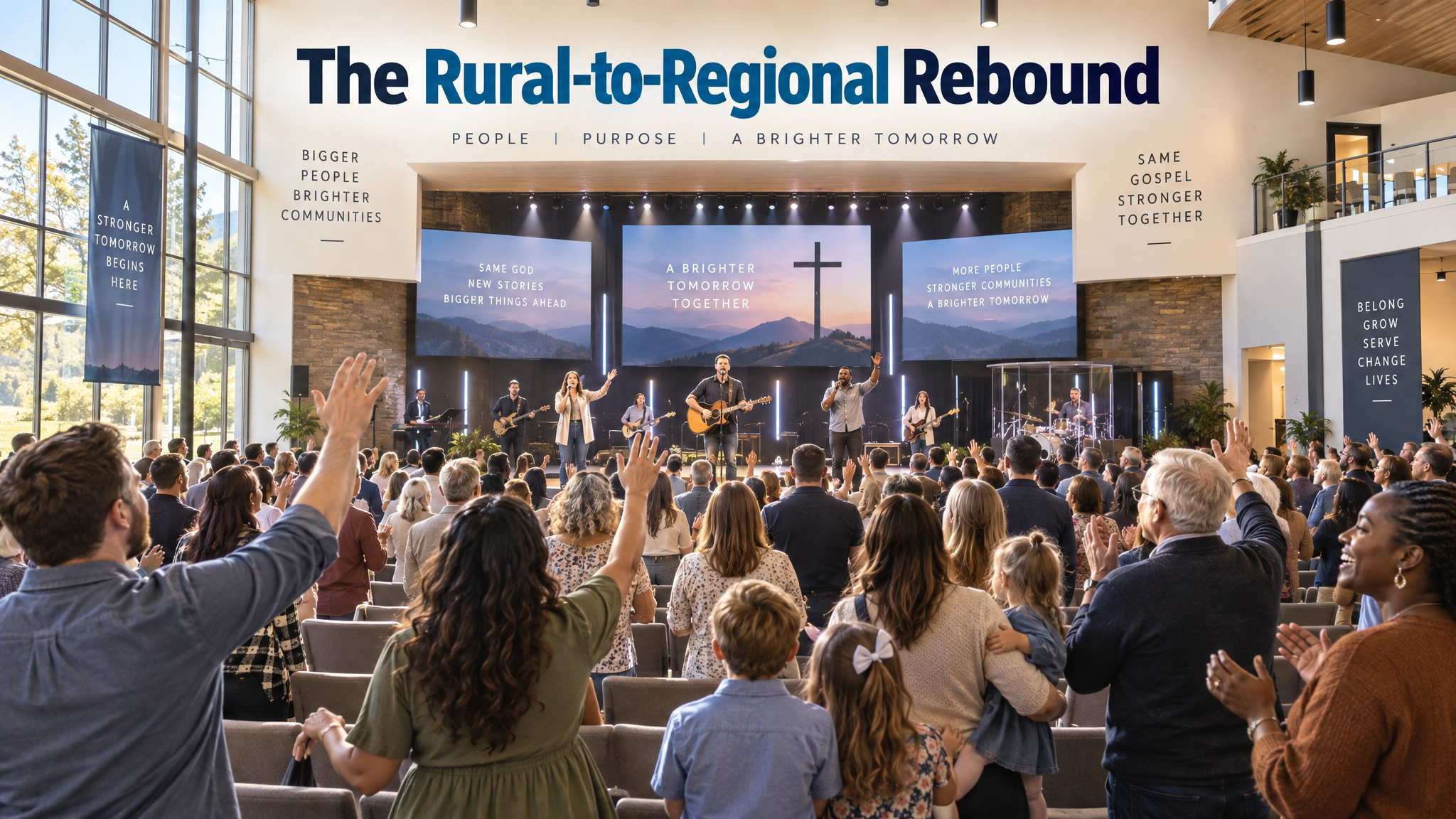
The Rural-to-Regional Rebound: A Case Study on Scaling Sustainable Church Growth Through Digital Integration at Northwood Community Church

Church Growth
The Data-Driven Expansion: A How-To Guide for Using Predictive Analytics to Identify High-Impact Locations for New Church Campuses

Discipleship
The Discipleship Engine: A How-To Guide for Designing Scalable Micro-Group Ecosystems for Sustainable Spiritual Formation
Explore FaithBridge